
Feb
Blog, General Information, Gouda
Why I chose to make Gouda as my first try at a hard cheese.
When I first started making cheese, I had just a few goats and focused on soft cheeses and feta. Over time the herd grew to about 100 goats. Eventually, we added a cow to our smallholding—first a Jersey and later a Holstein. After completing a course in AI (not the AI we’re all talking about now, but artificial insemination!), I had access to cow’s milk in a consistent and reliable way. It felt like the natural moment to move on to hard cheeses.
I settled into a simple, workable routine with the cow’s milk. On Saturdays, Sundays, Tuesdays, and Thursdays, I skimmed the milk. The skim milk was used for drinking and yoghurt (I never really enjoyed goat’s milk yoghurt or drinking milk, and neither did my children), and the cream went into butter. On Mondays, Wednesdays, and Fridays, I kept the milk whole and used it for cheesemaking.
The question then became: which hard cow’s milk cheese should I start with?
When you’re making hard cheese for the first time, it makes sense to choose something that matures relatively quickly. I decided on Gouda.
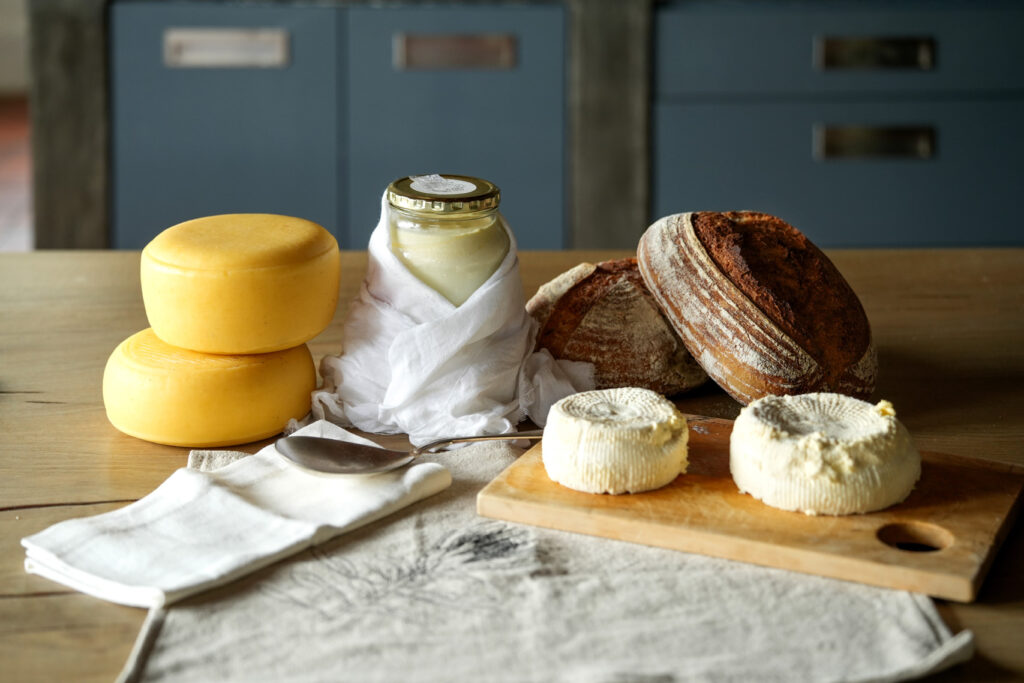
One of Gouda’s big advantages is its flexibility. You can make it in many different sizes, and those sizes mature at very different rates. A small 500-gram Gouda can be ready for the table in about three to four weeks—which is invaluable when you’re learning. You can taste the cheese, go back to your notes, and see where things may have gone wrong. If the Gouda was too acidic, I’d cut the curds a little smaller next time. If it was too dry, I’d do the opposite.
These small, quick-maturing Goudas are rich and creamy, and very rewarding. As my confidence grew, I started making larger cheeses—Goudas of 5 to 10 kg—which required much longer maturation. With time, the flavours of these bigger cheeses become more complex: firmer, drier, and nutty. A Gouda matured for up to a year can develop flavours similar to a strong Cheddar and may even form some of the tyrosine crystals you find in Parmesan, contributing that deep umami character.
Of course, smaller Goudas—around 1 kg—can also be matured for longer periods to develop more complexity. The challenge there is managing moisture, as smaller cheeses are more prone to drying out if conditions aren’t just right.
This versatility in size and flavours make Gouda and interesting cheese to make. It can become even more interesting when one starts not just concentrating on the size and maturation times but on the time of year the cheese is made. A spring cheese will be more buttery and yellow, a winter cheese drier and whiter. If your gouda making should by chance develop into a little business ( in which case remember you will need quite a large room to mature your cheese in) it could be an advantage to market your cheese as a mild, yellow 1kg spring cheese or a 3kg drier whiter nutty winter cheese.
Lastly there is the possibility of adding herbs to a Gouda. Finest Kind sells a large range of herbs for adding to cheese. Gouda with chilli or Gouda with stinging nettle can make the Gouda more interesting too. These herbs will mask the natural complexity of the mature Gouda.