Sep
Blog, General Information
MOZZARELLA STRETCHING SECRETS
The difficult part of making mozzarella is the stretching part and so lets look at a few pointers here.
START WITH THE RIGHT MILK
Mozzarella is a stretched-curd (pasta filata) cheese, and that stretch depends entirely on the protein structure surviving intact until you’re ready to melt and pull it. That means your choice of milk matters more here than in almost any other cheese.
You can use milk from the super market but make sure it is full cream with the freshest expiry date possible. Standard milk from a supermarket is homogenized which means the fat globules have been broken down. This isn’t a dealbreaker, but it does make for a slightly softer curd, so adding a small amount of calcium chloride before renneting helps firm things back up.
It is better to use fresh, full cream milk from a farm if you can get it.
THE IMPORTANCE OF THE RIGHT CULTURE
The best bacteria for mozzarella are the combo of Lactobacillus delbrueckii subsp. Bulgaricus and Streptococcus thermophilus (Hansen’s TCC-4 or TCC -3 ) . Mozzarella-making involves warming the milk into the high 30s to low 40s°C for culturing and renneting, and the curd itself often gets cooked a bit further before draining. Both Streptococcus thermophilus and Lactobacillus delbrueckii subsp. bulgaricus are thermophilic organisms, meaning they’re happiest and most active in that higher temperature range (up to around 42-45°C).
Another reason to use this combo is that the two species of bacteria have a well-documented symbiotic relationship, the same one that makes yogurt cultures work so well. S. thermophilus grows first and produces small amounts of formic acid and CO2 that stimulate L. bulgaricus. L. bulgaricus, in turn, is more proteolytic — it breaks down milk proteins and releases free amino acids (like valine) that S. thermophilus needs to grow faster. Together they drive a noticeably quicker and more predictable rate of acid development than either species would on its own that matters enormously for mozzarella specifically, because you’re trying to hit that narrow 5.1-5.3 pH stretching window.
There’s a flavour angle too: L. bulgaricus contributes a slightly sharper, more traditional tang and some proteolytic flavour development, while S. thermophilus is comparatively mild, so the blend gives that characteristic clean, mildly tangy mozzarella flavour rather than something overly acidic or completely flat.
THE IMPORTANCE OF PH
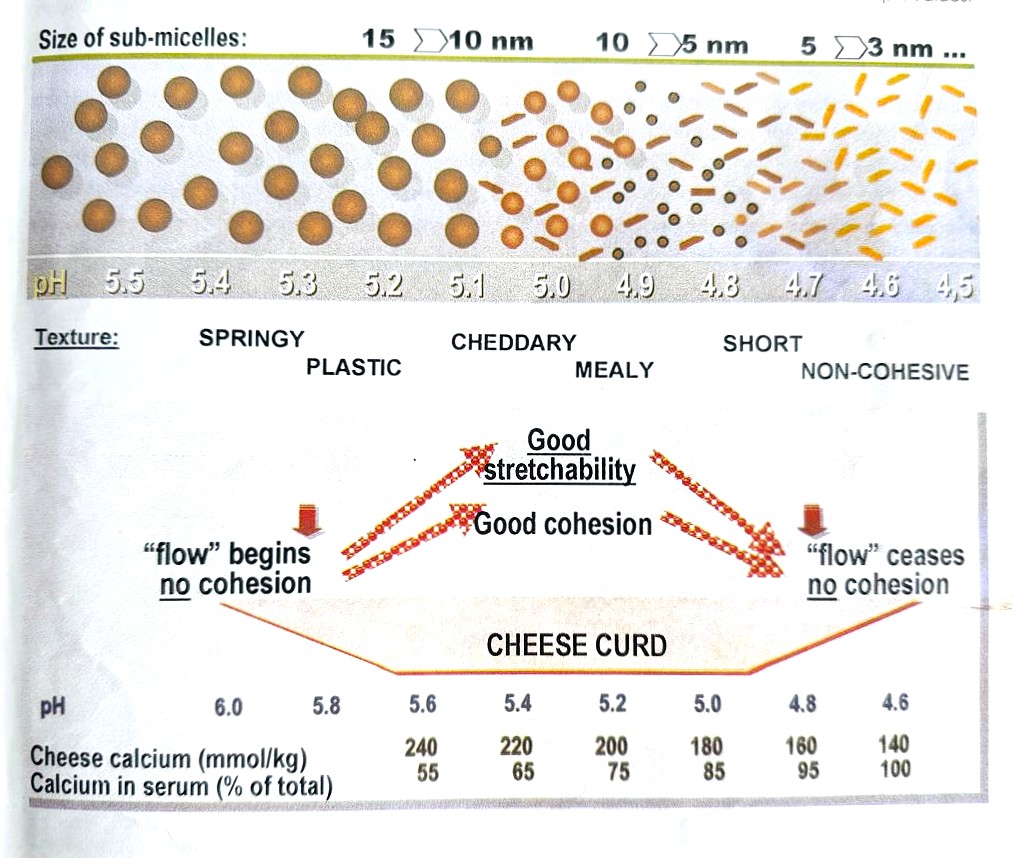
The “stretch” in stretched-curd cheese is really about calcium. A curd is formed after adding rennet to the milk. The curd is held together by calcium phosphate bridges between the casein proteins — a fairly rigid, non-elastic structure. As the culture in the curd converts lactose to lactic acid, the pH drops, and that falling acidity gradually dissolves those calcium bridges. At a certain point, the protein matrix becomes loose and pliable enough that when you apply heat, it flows, stretches, and re-sets into long glossy strands.
That “certain point” is fairly narrow — most cheesemakers aim for a pH of around 5.1 to 5.3 at stretching time. Above that range (say 5.4-5.5), the calcium bonds are still too intact, and the curd will just break apart in the hot water instead of stretching — you’ll see it crack and crumble rather than pull. Go too far below that range (under 5.0), and too much calcium has already leached out; the curd stretches but comes out grainy, greasy, and prone to weeping fat and whey.
Make sure to test the pH regularly with pH sticks. Stop guessing by taste, feel, or the clock, and test with pH sticks. Time-based recipes assume a fixed rate of acid development, but that rate shifts with room temperature, culture activity, and the milk itself, so the same recipe can need anywhere from 90 minutes to several hours to reach the correct acidity depending on the day. We do sometimes add very small amounts of citric acid towards the end if the acidity takes too long to develop.
THE STRETCH – TIPS
Once your curd is at the right pH, cut it into smaller pieces and submerge it in water heated to around 80-85°C — hot enough to soften the curd through to the centre without cooking it into rubber. Using gloves or two large spoons, gently fold and knead the curd in the hot water until it comes together into one mass, then start stretching and folding it back on itself, re-dipping in the hot water whenever it stiffens up. Do not handle the curds too much as you will lose butterfat.
You’ll know you’re there when the curd turns glossy and smooth and stretches into long, even ribbons without tearing. At that point, fold it into a ball, shape it, and drop it into a bowl of cold (ideally salted) water to set and cool.
Here are key stretching points :
- Cut the curd into manageable pieces before it goes into the water, so heat penetrates evenly.
- Work in smaller batches of curd at a time
- Do not pour the water directly onto the curd but pour it down the side of the bowl
- Pre – warm the curds with water at 80-85°C and gently stir, throw this water out
- Add fresh water at 80-85°C and maintain this temp the entire time
- Use a thermometer rather than judging by eye or feel.
- Top up with a splash of near-boiling water between batches if you’re doing several rounds.
- Wear gloves (or use two large spoons) — the curd itself needs to stay hot enough to remain workable, so you’re handling it close to that same 80°C+ range.
- Fold and knead gently rather than overworking it — too much handling causes the loss of butterfat and toughens the final texture.
- Re-dip in the hot water the moment it starts to stiffen up mid-stretch; don’t try to force a stretch out of curd that’s cooled too far.
- Stop once it’s glossy, smooth, and stretches into long ribbons without tearing — that’s the visual cue you’re done.
- Shape it immediately, then drop straight into cold (ideally salted) water to set.
Have a look at “BelGioioso Fresh Mozzarella Curd Stretching Instructions” on YouTube (https://youtu.be/nNYEvNEcWtI?si=4YweSmBZdDtEygxp ) for some further tips.